Life coach vs therapist: which one do you need? Here’s the simple split. A therapist is a licensed clinician. She can diagnose and treat mental health conditions. Much of that work looks back at what shaped you. A personal development coach works in your present and future. Together, you build goals and the follow-through to reach them.
So how do you choose? Start with your daily life. Is something disrupting how you function? Then a licensed clinician is trained for that. Does life work, yet feel stuck? Then coaching often fits better.
Still, many women sit right in the middle. And most articles stop at that exact point.
I’m Arecia Hester, a Certified Professional Life Coach in Los Angeles. I’m also certified through the Certified Life Coach Institute. I work with capable, respected women across the South Bay who feel worn down. Some already see a therapist. Others are a strong fit for coaching. Plenty use both at once, and that’s allowed.
First, a quick note. I’m a coach, so this page offers no assessment of you. Instead, it shows what each profession is built to do. It also shares questions that help women find their own answer. When that answer looks clinical, a licensed professional makes the call.

A therapist earns a graduate degree first. Next, she completes supervised clinical hours. Then she passes a state licensing exam. In California, a state board issues that license. That board can also discipline her or revoke it. As a client, you gain real protection from that oversight.
Therapy exists to treat. A therapist assesses your symptoms and names the condition. Then she treats it with an evidence-based method. That might mean cognitive behavioral therapy, EMDR, or psychodynamic work. Trauma, grief, depression, and anxiety all fit her scope. Disordered eating, substance use, and safety concerns fit there too. Those areas belong with clinicians.
Consider talking with a therapist if these sound familiar:
Coaching has no state license, and credentials are voluntary. I’ll return to that below, because it shapes how you choose. I hold two coaching credentials. The first is Certified Professional Life Coach through IAPRC. The second is Certified Professional Coach (CPC) through the Certified Life Coach Institute. They show the training behind each session.
Coaching moves you forward. I practice personal development coaching, and it follows a clear path. First, we look honestly at where you are. Next, we define what you truly want. Then we build the steps between the two. Along the way, you gain lasting skills. You’ll set boundaries without apology. You’ll make decisions and stand by them. You’ll ask clearly for what you need. And you’ll move before you feel fully ready.

Coaching tends to fit when these sound like you:
Research backs the method, too. A meta-analysis of workplace coaching studies appeared in The Journal of Positive Psychology. It found significant positive effects on every outcome measured. Effect sizes ranged from 0.43 for coping to 0.74 for goal-directed self-regulation. So coaching reliably moves people forward. Treatment, however, stays with clinicians.
| Therapist | Personal development coach | |
|---|---|---|
| Licensed by the state | Yes | No |
| Can diagnose a condition | Yes | No |
| Can treat a condition | Yes | No |
| Primary time focus | Past and present | Present and future |
| Central question | What happened, and how do we heal it? | What do you want, and how do we build it? |
| Typical fit | Symptoms disrupt daily life | You’re functioning and want more |
| Insurance | Sometimes, with a diagnosis | No |
| Typical cash cost per session | About $96 to $240 in Los Angeles* | Most charge $110 to $150 |
*Therapy fees are general estimates and vary widely by therapist.
The life coach vs therapist cost row surprises most people. Both options land in a similar range. So price alone makes a weak tiebreaker.
Many women fit both descriptions. When that happens, the life coach vs therapist question needs a sharper filter. These three questions help. Use them to think it through. The decision always stays yours.
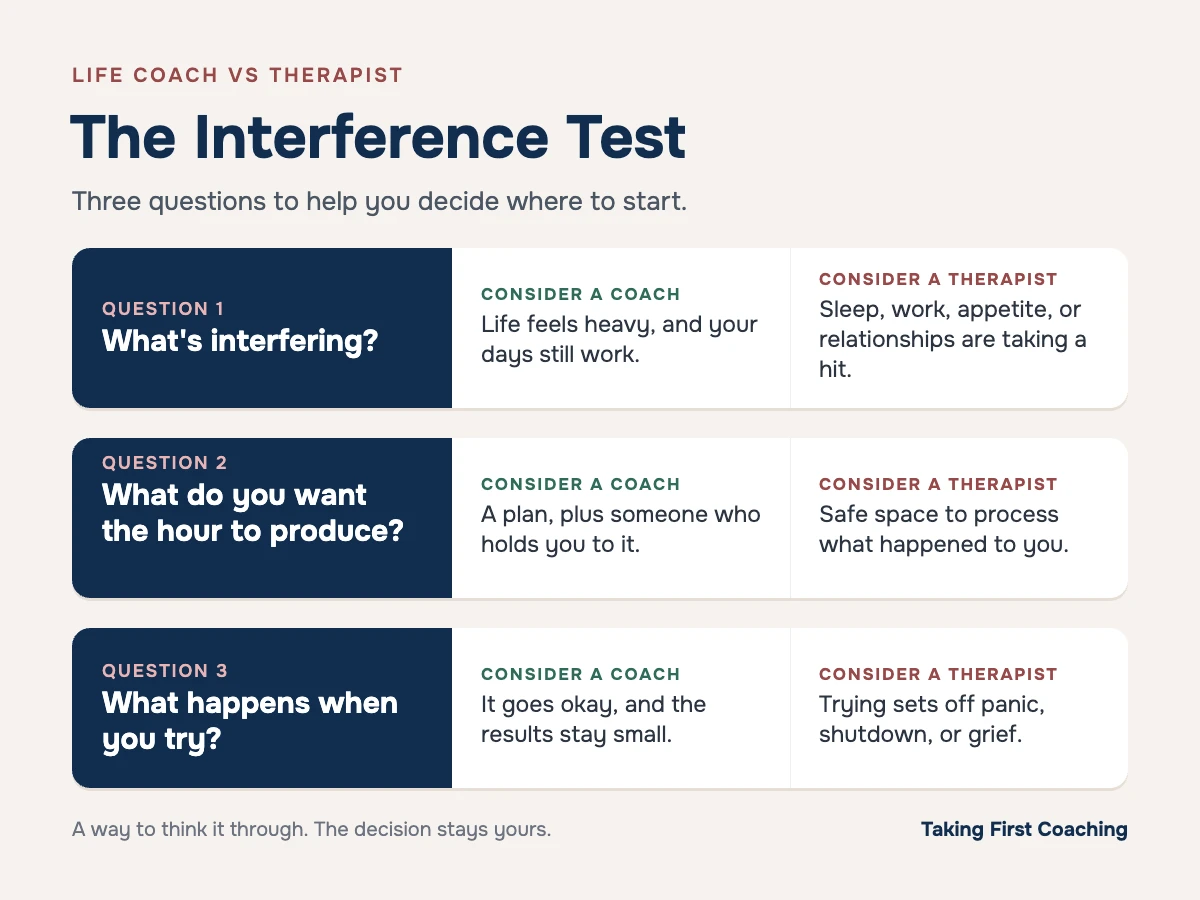
Look at interference first. Pain shows up in every hard season. Interference goes further. It means the struggle is cutting into your sleep, work, appetite, or relationships. That pattern is worth taking to a clinician. Meanwhile, heavy days that still work usually suit coaching.
Some weeks, you need to feel understood. You want a safe place to process what happened. Other weeks, you need a plan. You also want someone to hold you to it. Both needs are valid. Naming yours often answers the question.
Pick the smallest version of your change. Then test it once this week. Did it go okay, with small results? Then you have a strategy problem, and a coach can help. Did it trigger panic, shutdown, or overwhelming grief? Then bring that to a licensed professional first.
Most women arrive with a scenario, so here’s the test in real life.
| What’s happening | Often points toward | Why |
|---|---|---|
| Dreading Monday, sleeping fine | Coaching | It’s tied to work, and your capacity is intact |
| Dreading everything, sleeping badly | A therapist | The flatness reaches past the job |
| Hate the job, no idea what’s next | Coaching | Direction problems respond to structure |
| Grieving a loss you can’t move past | A therapist | Grief work is clinical work |
| Passed over again, second-guessing yourself | Coaching, then reassess | Start with the pattern and the conditions |
| Panic attacks before meetings | A therapist | Clinicians treat panic directly |
| Finished therapy, ready to build | Coaching | Healing closed, so planning opens |
Treat the middle column as a starting point. Many women see themselves in two rows. Both conversations stay open.
Did the passed-over row sound familiar? Then read overcoming self-doubt next. Also, being BIWOC in the workplace covers the version shaped by the room around you.
One more test costs nothing. Book a free consultation with a coach. Then book an intake call with a therapist. Talk to both in the same week. Within 20 minutes, you’ll usually sense which one lets you breathe.
Yes, and many women do. The two roles cover different ground, so they pair well. Two habits keep the setup useful and affordable.
Each provider works independently. Still, naming the arrangement keeps everyone clear on scope. Coaches also hold no clinical privilege, so openness helps.
Bring your past, symptoms, and processing to your therapist. Bring goals, decisions, and accountability to your coach. When a topic shows up in both rooms, notice which room moves it forward.
Many women come to coaching right after therapy. They’ve processed something hard. Now they want to build. That sequence works well. Coaching simply sits beside therapy, in its own lane.
You’re likely ready when the crisis has passed. You can name what you want with some confidence. And your main hurdle is now follow-through. That choice stays flexible, too. Women return to therapy all the time. A good coach supports that move.
The reverse happens as well. Sometimes something clinical surfaces during coaching. That’s useful information. I’ll name what I notice, without a label. Then I’ll help you find a licensed professional. As a coach, I leave diagnosis and treatment to clinicians. I hold that line out of respect for their work.
I’d like you to hear this from me first. In 2020, a Stanford psychiatrist wrote about life coaching in Perspectives on Psychological Science. He observed that it “operates in a regulatory vacuum, with no education, training, licensing, or supervision requirements for coaches and no specific legal protections for any harmed clients.”
He’s right. That’s why a credential matters so much here. Anyone can print business cards and start booking clients. So ask every coach these five questions. Please ask me, too. I’ve answered each one below as an example.
Ask for the organization’s full name. Then spend two minutes looking it up before you book.
I hold two credentials. The first is Certified Professional Life Coach, issued by IAPRC. The second is Certified Professional Coach (CPC), Level 1, from the Certified Life Coach Institute (CLCI). You’ll find the CLCI badge in this site’s footer. Behind it sit over 30 years of leadership experience. That’s where I learned most of what I know about women at work. I’m also trained in culturally competent, trauma-informed coaching. Plus, Taking First is accredited with the Better Business Bureau. So you can verify it all yourself.
A strong coach answers this one right away. Her answer shows she has thought about your safety.
Here’s mine. I name what I notice, without a label. Then I help you find a licensed professional. Diagnosis and treatment stay with clinicians. I’d always rather refer early and keep you well served.
A thoughtful answer here tells you a lot. Coaches who claim every area usually understand very little.
Treating conditions and prescribing anything fall outside my scope. Changing another person for you does too. My focus is working women in and around Los Angeles. Many are Black women and women of color facing real workplace pressure. My coaching is culturally competent and trauma-informed. That shapes who it fits best.
The answer should be a clear yes. The agreement should cover scope, fees, and cancellation.
Yes. You’ll have it in hand before any money moves. And the first consultation is always free.
Some coaches accept everyone who calls. That approach usually shows by session three.
Yes, and I have. Sometimes a licensed professional would serve you better. Other times, next year simply suits you better. Saying so costs me a client. However, it saves you months.
| Therapy | Personal development coaching | |
|---|---|---|
| Per session, cash pay | About $96 to $240 in Los Angeles | Most charge $110 to $150 |
| Per session, with insurance | Copays around $24 to $90 | Not covered |
| Average benchmark | About $180 in Los Angeles and $150 nationally | $234 per hour globally (ICF 2025) |
| HSA or FSA eligible | Often, when treating a diagnosed condition | Generally no |
| Sold as | Single sessions | Packages and multi-month engagements |
Please treat these therapy prices as general estimates. Real fees vary widely from one therapist to the next. License type, specialty, and experience all affect the rate. Location, session length, and your insurance plan matter as well. So always confirm a therapist’s fee before booking. The Los Angeles figures come from OpenMyPro’s therapy price data. Coaching rates come from Thumbtack’s life coach cost guide.
Insurance covers therapy only with a diagnosis. Coaching carries no coverage at all. That’s because the IRS treats anything “merely beneficial to general health” as a personal expense.
At Taking First, personal development coaching packages range from $150 to $2,000. Your price depends on session frequency and program length. Payment plans are available. I also keep a few sliding-scale spots, based on capacity. Is cost your main hurdle? Then bring it up on the consultation call.
Neither is better. They simply do different work. A therapist treats conditions and answers to a state licensing board. A coach builds skills and momentum. So your choice depends on daily function. Is something disrupting it? Start with a therapist. Are you functioning and wanting more? Then coaching likely fits.
Start by asking what’s interfering. Have your sleep, focus, appetite, safety, or relationships suffered? Then talk with a licensed therapist first. Are you managing, yet stuck or unclear? Then coaching is likely the better investment. Do both descriptions fit? Try a free consultation with each. You’ll usually know within a week.
Rates vary widely. On Thumbtack, most life coaches charge $110 to $150 per session. Meanwhile, the International Coaching Federation’s 2025 study reports a $234 hourly global average. At Taking First, packages range from $150 to $2,000. Payment plans and limited sliding-scale spots are available.
No. Diagnosis is a clinical act, and it requires a license. As a Certified Professional Life Coach, I leave diagnosis and treatment to clinicians. If something clinical appears, I’ll describe what I notice. Then I’ll help you find a licensed professional.
Not at all. Many women use both. A therapist helps with what happened. Meanwhile, a coach helps with what you’re building next. If two providers strain your budget, see them one after the other.
Usually, no. Health insurance pays for medically necessary treatment. Coaching falls outside that definition. HSA and FSA funds generally stay off the table too. However, some employers fund coaching through development or education benefits. So send your HR team a quick email first.
I coach in person across greater Los Angeles. I also coach online, so you can skip the commute. See my local pages for Carson, Gardena, Hawthorne, and the rest of the South Bay. Is your question mainly about work? Then professional development coaching may be the best place to start.
Sessions run about an hour. We meet weekly or every other week. Most engagements last 6 to 12 months, with a 6-month minimum. Limited Saturday sessions are available for busy weeks.
Your first step is free. Book a free consultation and tell me what’s going on. Together, we’ll settle your life coach vs therapist question. And if a therapist would serve you better, I’ll tell you.

